Before We Begin
Every report explains the Australian startup ecosystem. This one is trying to name the pattern underneath it. Because once you can name the pattern, you start playing a different game.
Most founders experience the Australian ecosystem as a gauntlet.
You build something real.
A grants team tells you you're not proven enough.
An angel tells you that you need more traction.
A VC tells you the market thesis isn't clear.
You sharpen the thesis.
A corporate tells you it doesn't fit their existing systems.
After enough of these conversations, it starts to feel personal.
Like the problem is you.
Like your startup is somehow not ready.
It isn't.
The problem is something more structural.
And more interesting.
// The Core Framework
Australia's startup ecosystem doesn't behave like a funnel.
It behaves like a hall of mirrors.
A founder doesn't move through one consistent path with a clear finish line. They move through a sequence of different rooms — each one re-reading the same startup through an entirely different lens. And here's what makes it disorienting: none of these rooms are wrong. They just don't talk to each other.
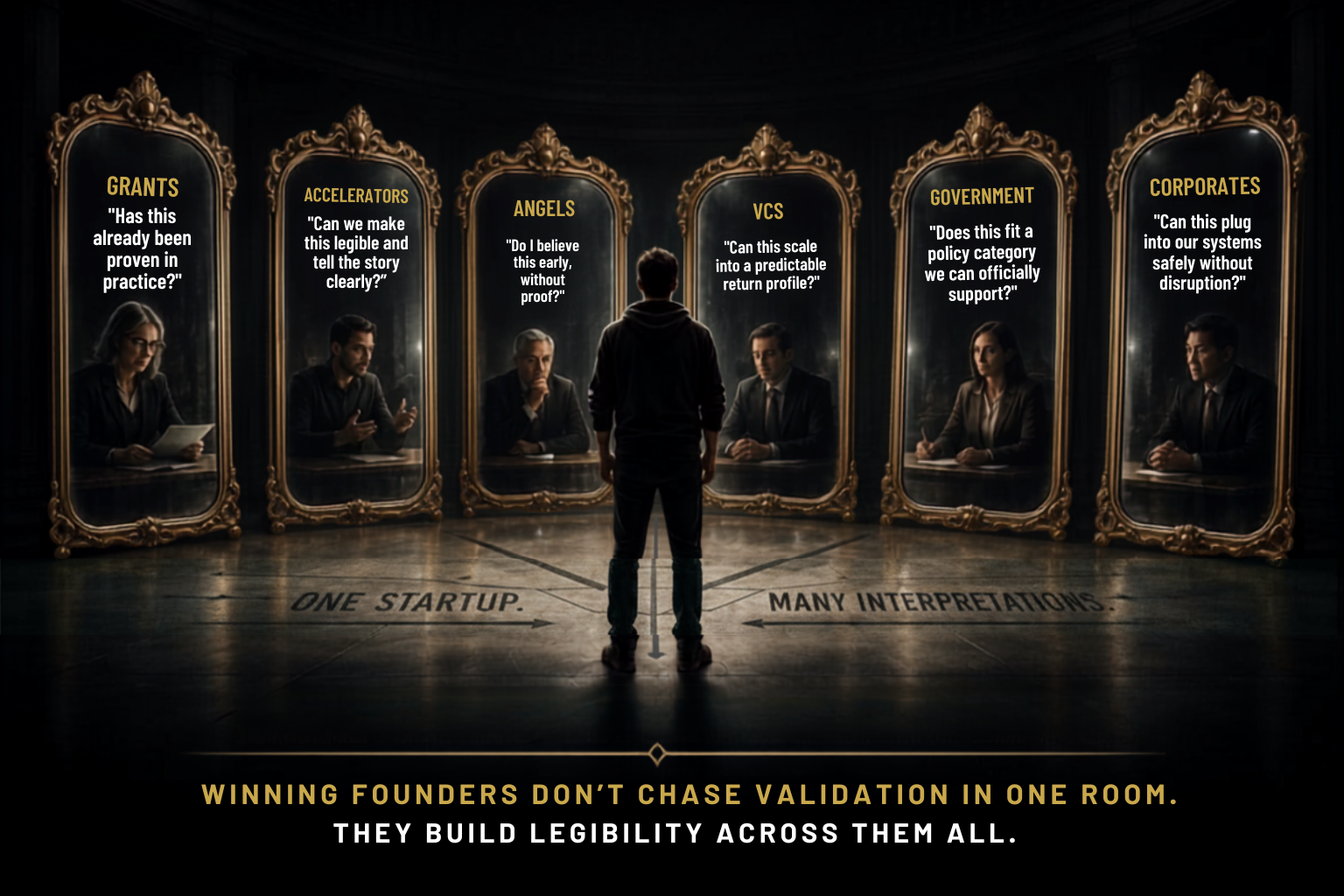
Grants Room
"Has this already been proven in practice?"
Accelerators Room
"Can we make this legible and tell the story clearly?"
Angels Room
"Do I believe this early, without proof?"
VC Room
"Can this scale into a predictable return profile?"
Government Room
"Does this fit a policy category we can officially support?"
Corporates Room
"Can this safely plug into existing systems without disrupting them?"
// What This Looks Like in Practice
A B2B payments startup applies for a government grant. The grants assessor asks for market traction data. The company has $200K ARR and strong customer retention. Rejected — "insufficient commercial validation." Six weeks later, the same company pitches a Series A VC. The VC asks why they're wasting time on grants instead of scaling. Both rooms looked at the same company and saw a different problem.
A climate tech founder gets into an accelerator. The program helps them sharpen their narrative. Three months later they pitch a corporate partner. The corporate says it's too early-stage for their procurement process. The accelerator said they were ready. The corporate said they weren't. Nobody was lying — they were reading the same company through completely different lenses.
A startup in Australia is not evaluated once. It is continuously re-interpreted by different systems that do not share the same definition of "ready." Progress is not purely about building forward. It is about maintaining coherence while your company is repeatedly reclassified.
Most founders believe: "If I improve the startup, outcomes will improve linearly."
The system behaves like: "If the interpretation of the startup aligns across rooms, momentum appears suddenly."
The real game is not just building something valuable. It is building something that survives repeated reinterpretation without losing coherence.
This report is built around that insight. Every section that follows — capital, grants, ecosystem, regulation — is essentially a map of one of those rooms: what lens they use, what they need to see, and how you remain legible inside them without losing the plot of your own company.
Read it that way and the whole landscape becomes navigable. Not easy. Navigable. There's a difference, and it matters enormously.
Executive Summary
Australia is sitting on a gold mine and arguing about the shovel.
Here's the honest picture: Australia has world-class universities, a stable democracy, rule of law, proximity to the fastest-growing economic region on the planet, and a track record that includes Atlassian, Canva, Afterpay, Airwallex, and Rokt — companies that collectively represent tens of billions in shareholder value built from Australian soil.
And yet. Listen to founders talk about building here — on podcasts, in postmortems, in funding threads — and the same story keeps surfacing: brilliant idea, brutal journey. Funding rounds that drag for nine months. Government grants that require a PhD to understand. A Series B market that barely exists. A talent pool that gets raided by San Francisco the moment someone figures out how to use a VPN.
This report doesn't shy away from that friction. But it also refuses the lazy narrative that Australia is a startup backwater. The truth is more interesting — and more actionable — than either the boosters or the cynics suggest.
The Core Thesis
Australia's startup ecosystem is adolescent, not broken. The infrastructure is building in real time. The window for founders who understand how to navigate the hall of mirrors — and who aren't waiting for it to be perfectly aligned — is right now.
Funding & Capital
Show me the money — and where it goes.
$5.1B was deployed into Australian startups in 2025 — the third-largest funding year on record.[2] But here's the number that really explains the ecosystem: the largest 20 funding rounds accounted for approximately 58% of all capital raised.[2] Capital doesn't flow evenly here. It concentrates around conviction. Once a company becomes truly legible to investors, capital often compounds quickly. Before that point, it barely moves at all. That's not a bug someone is going to fix for you — it's how conviction-driven capital behaves.
Below Series B, Australia does not have a capital absence problem — it has a capital navigation problem. The challenge at those stages is not whether support exists but understanding how to access it. Above Series B, the absence is real, and this report treats it as such.
// Australia's Capital Contradiction
The money exists. The question is why so little of it moves from the top of this stack to the bottom — and what happens when it does.
The Capital Stack
| Stage | Typical Source | Cheque Size | Reality Check |
|---|---|---|---|
| FFF / Bootstrap | Friends, family, founders | $10K–$100K | Accessible Watch your cap table from day one |
| Pre-Seed | Angels, syndicates, micro-VCs | $100K–$500K | Active Ecosystem maturing quickly here |
| Seed | Local VCs, some US/SG funds, CVCs | $500K–$3M | Competitive Deals happening; fewer funds than ideal |
| Series A | AU VCs + international co-investors | $3M–$15M | Thin Often requires US revenue as proof point |
| Series B+ | International VCs, growth equity | $15M–$100M+ | Scarce The real structural gap in Australian capital |
| Growth / Pre-IPO | International PE, US late-stage | $100M+ | Rare Almost entirely offshore capital |
What Founders Should Actually Do Here
At Seed stage: build relationships with AirTree, Blackbird, and Square Peg 12 months before you need them. These funds overwhelmingly move on warm introductions and pattern recognition built over time. Cold inbound works occasionally — plan as if it won't. Attend their public events, engage with their partners on LinkedIn, and ask portfolio founders for introductions when the time is right.
At Series A: you need international proof points before you start the raise. US revenue, a US design partner, or a credible US pilot gives local VCs the signal they need to lead and international VCs a reason to look. Without it, expect six months of conversations that go nowhere.
At both stages: run your raise process in parallel, not sequentially. Build a list of 15–20 target investors, approach them in coordinated waves, and create real deadline pressure. A raise with no timeline dies by attrition.
The data also reveals something important about founder behaviour: 59% of founders in 2025 pursued both Australian and international investors simultaneously, with 11% pursuing international investors only.[2] Founders have already internalised what this report argues — startup formation and startup scaling operate in different systems. They're navigating multiple rooms at once.
Who's Writing Cheques
The Home Team — Australian VCs
The domestic VC landscape has matured significantly since 2015. Blackbird Ventures is the benchmark — they backed Canva at seed, before the numbers made conventional sense, and have since backed Safety Culture, Zoox, and others. Square Peg Capital (Fiverr, Rokt, Papaya Global), AirTree Ventures (Employment Hero, Linktree, Prospa), Folklore Ventures, Rampersand, and Skip Capital round out the core. Excellent investors — but fund sizes mean most can't lead rounds above $10–15M without pulling in international co-investors.
Angels & Syndicates
Sydney Angels, Melbourne Angels, and Scale Investors form a growing angel layer, alongside platforms like VentureCrowd. Australia's successful exits have now created a meaningful cohort of second-wave angels. Every Atlassian employee who did well in the IPO became a potential angel investor. Every early Canva employee is a future seed cheque. Each unicorn exit seeds the next generation — and with 18 unicorns at the end of 2025, 21 after Q1 2026, that pool is deeper than it's ever been.
Superannuation — The Sleeping Giant
Australia's superannuation system holds $4.5 trillion in assets as at December 2025.[6] That is roughly one and a half times the country's annual GDP. The amount flowing into domestic venture has historically been less than 1%. Here is the structural irony: the reason is not unwillingness — it is architecture. Super funds now write cheques too large for most domestic VC funds to absorb, and fee disclosure rules make venture capital look expensive on paper even when it outperforms on returns. Mandala Partners, in research commissioned by the Australian Investment Council, models that fixing those two settings alone could unlock up to $54 billion in additional private equity and venture capital for Australia.[22] Meanwhile, family offices have moved into the gap — now comprising close to 50% of all active venture capital investors by volume, up from around 20% four years ago.[22] The super pool remains the single biggest untapped capital reservoir in the country. The policy conversation around how to unlock it is the most consequential one happening in the ecosystem right now.
Corporate Venture
NAB Ventures, Westpac's Reinventure, Titanium Ventures (formerly Telstra Ventures), and Main Sequence Ventures (CSIRO) form the CVC layer. Valuable for strategic partnerships and patient capital — but move in with clear eyes. Corporate VCs move slowly and often have strategic strings attached.
Founder Warning
Fundraising in Australia is commonly reported to take 20–40% longer than comparable rounds in the US. Build more runway than you think you need before starting a raise. The best time to raise is when you don't desperately need to — not a cliché, a survival rule.
The most current read on the market comes from Q1 2026, where Australian startups raised $1.8 billion across 107 rounds — the strongest first-quarter result since the 2022 peak, representing more than double the levels recorded in Q1 2024.[21] The recovery is real but uneven in ways that matter for founders: the top 20 deals accounted for 79% of total capital, and the largest single deal represented 11% of the quarter's total. Sub-$10M rounds contributed their lowest share of capital in five years. The structural pattern described throughout this report — capital concentrating at the top while early-stage access tightens — is not improving. It is accelerating. Three new Australian unicorns emerged in Q1 2026: Advanced Navigation (AI-enabled navigation and autonomous systems, A$1.5B valuation), Gilmour Space (sovereign launch capability, A$1.5B valuation), and Neara (infrastructure modelling software for utilities, A$1.1B valuation). Notably, all three are embedded in physical-world systems and critical infrastructure — a clear signal that the next generation of Australian unicorns will look very different from the SaaS and fintech leaders of the previous decade.
As of Q1 2026, median seed valuation has reached $16M — a 35% increase versus the 2025 average and more than double the $7.7M median recorded in Q1 2024.[21]
Government Capital
CSIRO Kick-Start matches early-stage funding. ARC Linkage Grants fund university-industry collaboration. Export Finance Australia supports growth-stage companies going international. The National Reconstruction Fund targets sovereign capability sectors. Slower and more compliance-heavy than VC, but meaningful non-dilutive tools — especially for deep tech.
Grants & Incentives
Non-dilutive capital exists. Many founders leave it on the table.
The grants room operates on one question: has this been proven in practice? Many founders skip grants entirely because they don't think they qualify — and then discover they left hundreds of thousands of dollars unclaimed. Australia's grant landscape spans federal tax incentives, export grants, and state-level programs. The problem isn't existence of support. It's cognitive overhead.
The Big Three
1. R&D Tax Incentive (RDTI)
The jewel in the crown. The RDTI provides a refundable tax offset equal to your company tax rate plus an 18.5% premium for eligible companies with aggregated annual turnover under $20M and in a tax loss position — if you're profitable, the offset applies against your tax payable instead.[9] For most small companies on the standard 25% company tax rate and in losses, that's a 43.5% refundable offset — meaning a startup spending $500K on eligible R&D, while in a loss position, can receive up to $217,500 back in cash. Not a tax deduction. Cash in your account.
Who Should Claim This
If you're building software, hardware, AI, or novel technical systems in Australia, parts of your work may qualify. If you're resolving genuine technical uncertainty through experimentation — not just building features — there's a real chance you qualify. The expensive mistake isn't asking the question — it's never checking, or claiming without documentation. Talk to an R&D advisor early.
Why Founders Miss This
Registration deadline. Registration with AusIndustry must happen within 10 months of the end of your income year. The real risk isn't a mismatched deadline; it's simply not knowing the window exists and missing it by default.
Documentation friction. The claim depends on contemporaneous records covering both the technical experimentation and the expenditure — logs, meeting notes, technical specifications, and cost records — kept as the work happens. Trying to reconstruct documentation retrospectively is both difficult and risky under audit.
Mindset barrier. The most common reason founders don't claim: "we didn't think we qualified." If you're solving a technical problem where the outcome isn't known in advance, there's a genuine chance you do. That's a question for an advisor, not a vibe — ask before you decide.
Structure. You need to be a company to claim — trusts and sole traders can't. Many founders don't set up the right structure early, or don't run R&D costs through the company's P&L correctly, and only discover the problem once it's too late to fix retrospectively.
What Founders Should Actually Do Here
Register with AusIndustry within 10 months of the end of your income year — don't let the deadline sneak up on you. Appoint an R&D advisor in your first month of operation. Keep a simple activity log (even a shared doc updated weekly works). For the EMDG, track every dollar of eligible international marketing spend from the first meeting — the paperwork at claim time is significantly easier if the records are clean. These two programs alone can return $300K+ to a pre-Series A company. That's real runway, with zero dilution.
| Factor | Detail |
|---|---|
| Refundable offset rate | Company tax rate + 18.5% premium. For most small companies (25% tax rate) = 43.5% total. Cash refundable if in a loss position; otherwise offsets tax payable. |
| Non-refundable rate (larger companies) | Company tax rate + 8.5% (first 2% R&D intensity) or + 16.5% (above 2% intensity) |
| Turnover threshold | Under $20M aggregated annual turnover for the refundable offset |
| Eligibility test | Genuine experimental R&D with technical uncertainty — not routine software development |
| Critical timing | Register with AusIndustry within 10 months of the end of your income year — most founders miss this and cannot claim retrospectively |
| Common failures | Claiming routine development, poor contemporaneous documentation, late registration |
| Advisor cost | $5K–$30K depending on complexity; typically worth it for claims over $50K |
RDTI — Proposed Changes from 1 July 2028
Heads up. The 2026–27 Federal Budget proposed seven changes to the RDTI — not yet law, but coming if legislated. The rates and thresholds in this section reflect current law and stay accurate until 1 July 2028 at the earliest.
What changes and why it matters to you: supporting R&D activities lose eligibility entirely — only core R&D activities will qualify under the new rules, so your advisor needs to audit what you are currently claiming. The refundable offset gets restricted to your first 10 years of operation, so if you are approaching that window, timing matters. The minimum annual spend threshold rises from $20,000 to $50,000 — very early-stage claims may fall below the floor.
The good news: the core R&D offset rate increases by 4.5 percentage points and the turnover eligibility threshold rises from $20M to $50M, meaning more companies access the cash refund. If these changes pass, the incentive gets more generous for core R&D and more accessible by turnover — but narrower in scope.
Confirm your current and future eligibility with a registered R&D advisor before 2028 planning.[24]
2. Export Market Development Grants (EMDG)
If you're spending on international marketing, trade shows, or global business development, the EMDG provides tiered, capped grants you must match dollar-for-dollar with your own spend — no longer a reimbursement scheme since the reforms.[10] Eligibility requires a minimum capacity to spend $20,000 per financial year on eligible export marketing activities. Grants are tiered: Tier 1 ($20K–$30K for early exporters), Tier 2 ($20K–$50K for established exporters in existing markets), Tier 3 ($20K–$80K for exporting into new markets). Applications for the current round — Round 4, funding FY2025–26 and 2026–27 — closed in late 2024; the next round is yet to open. Sweet spot: Series A companies actively entering international markets with real marketing spend.
3. State-Based Programs
| State | Key Programs | Strength |
|---|---|---|
| NSW | MVP Ventures, Tech Central precinct, Investment NSW | Strong |
| VIC | Innovation Victoria (formed July 2026 from the LaunchVic/Breakthrough Victoria merger), The Startup Network | Strong |
| QLD | Advance Queensland, Innovation Hubs, Ignite Ideas Fund | Moderate |
| WA | Innovation WA, Future Jobs & Investment Attractions | Growing |
| SA | SA Startup Ecosystem, Department for Industry and Science | Moderate |
| ACT | Canberra Innovation Network, Invest Canberra | Niche / Defence |
Sector-Specific Programs
AI & Data: The National AI Centre runs programs targeting AI adoption and capability building across industry. Healthtech: Auscelerate (formerly MTPConnect) bridges medtech founders and clinical trials funding; the Medical Research Future Fund has specific digital health innovation rounds. Cleantech/Climate: ARENA and the Clean Energy Finance Corporation represent billions in available capital and are dramatically underutilised by digital economy founders. Defence: The Advanced Strategic Capabilities Accelerator (ASCA) — which replaced the former Defence Innovation Hub — is generous and massively underused by civilian founders with dual-use technology.
Further Reading — Government Grants for Australian Startups
AirTree Ventures maintains a comprehensive open-source guide to government grants available to Australian startups — covering programs beyond what this section covers, updated regularly, and free to use. If you're doing a serious grants audit, start here: airtree.vc/open-source-vc/government-grants-for-australian-startups
The Grants Trap
Grant-hunting can become a full-time job that distracts you from building. The discipline: only pursue grants where the total value justifies the time cost. The RDTI should almost always be claimed. Everything else — evaluate carefully. A grant that costs 40 hours to apply for and returns $20K is often a worse use of your time than a single great sales call.
Accelerators, Hubs & Ecosystem
The people and places where deals get done.
The accelerator room asks: can we make this legible and tell the story clearly? It's not evaluating your technology. It's evaluating your narrative coherence. The best accelerators don't just give you capital — they give you the language, the network, and the credibility signals that make the next room more receptive.
Accelerators Worth Your Time
Startmate — The Benchmark
Startmate is the closest thing Australia has to Y Combinator. The community it has built is exceptional — high-density operators, alumni, and investors. Its fellowship programs have become a meaningful entry point for people who didn't come through the traditional founder route. If you get in, go. The capital is modest. The network is not.
Stone & Chalk
Stone & Chalk operates hubs in Sydney and Melbourne with deep roots in fintech. The connections to major financial institutions make it valuable for B2B fintech founders who need enterprise distribution and credibility. The network density, particularly in financial services, remains its primary value proposition.
Spacecubed & PLUS Eight (Perth)
Spacecubed is the anchor of Perth's startup ecosystem — the community node for the entire WA tech scene. PLUS Eight, Spacecubed's accelerator arm, is specifically designed for high-growth startups and provides structured support, investor access, and mentorship. In a state that can feel disconnected from the east coast, Spacecubed and PLUS Eight are an important counterweight.
DECA
DECA (Digital Economy Council of Australia) occupies a unique position as a peak body representing digital economy companies at the policy level. Its value is real for founders who want to influence the regulatory environment they operate in — particularly those in fintech, data infrastructure, and digital platforms.
FinTech Australia
FinTech Australia has punched above its weight in getting ASIC and Treasury to hear founder perspectives on regulation. For fintech founders, membership is table stakes.
Hackathons: Australia's Most Underused Entry Point
Hackathons compress months of learning into a single weekend. They force you to stop planning, start shipping, and explain your idea to real judges under real time pressure. The prototype rarely survives. The relationships usually do.
For university founders, FoundersHack and Codebrew are the strongest domestic options. For everyone else, GovHack is Australia's largest open-data hackathon — open to all, running annually across the country, and structured around the kind of real-world public datasets that underpin genuine product problems.[25] In ecosystems like Solana, hackathons have become the front door to venture funding and global founder networks. Australia's hackathon ecosystem is moving in that direction. It is not there yet — but it is worth watching, and worth entering.
Canva: Simultaneous Legibility Across Incompatible Systems
Canva didn't become a A$65B company[2] because Sydney's startup scene was perfect. It happened because Melanie Perkins was relentless about one thing: maintaining coherence across every room simultaneously — without changing what the company actually was.
To the VC room: a massive, underpenetrated global market with a clear wedge into the long tail of non-designers — a return profile story anyone could model. To the user room: design made simple and accessible for people who'd been locked out of professional tools by complexity and cost. To the enterprise room: a workflow integration that reduced design bottlenecks without requiring IT procurement cycles.
Three completely different lenses. One company. No contradictions between them. Blackbird has told this story publicly: a personal meeting with Perkins, a conviction in the mission that preceded the numbers making sense. Call it what it was — a bet on the person and the belief, ahead of the evidence. That coherence was an unfair advantage — arguably as decisive as the product itself.
Success came from simultaneous legibility across incompatible systems, not local validation first.
The University Layer
Nearly every major Australian university now runs an accelerator or innovation hub. The best — UNSW Founders, UniMelb's Melbourne Accelerator Program — provide genuine mentorship and seed funding. Where universities add value: deep tech commercialisation, clinical and life sciences, and connection to international research networks.
Communities That Matter
Antler Australia (pre-incorporation, global network of 45+ cities — underrated for co-founder matching). Women in Tech Australia for underrepresented founders. AWS Startup Community and Google for Startups — both run programs that are free and underutilised. Join one and go deep. Not five, going shallow.
AI: The New Default Layer
61% of capital went to companies with AI in their stack. So why does AI need its own section?
Because 61% of startup funding flowing into AI-enabled companies isn't a sector story anymore.[2] It's an infrastructure story. And the distinction matters enormously for how Australian founders should think about building.
When more than half of all invested capital gravitates toward a single category, one of two things is happening: either investors are making a speculative sector bet, or they're recognising that the underlying technology has become table stakes — something that has to be present for a company to be competitive, regardless of what the company does. The evidence points overwhelmingly to the second interpretation.
The winners will not be the companies that talk most about AI. They will be the companies where AI quietly disappears into customer value.
Australian investors have absorbed this shift. Cut Through's investor survey data shows the emphasis has moved decisively from AI branding to defensibility, integration, and measurable commercial outcomes.[2] A company that describes itself as "an AI platform" is increasingly being asked the same question as every other company: what problem does this solve, for whom, and at what margin? The AI label is no longer a shortcut to conviction. Demonstrated customer value is.
The macro picture reinforces this at the economy-wide level. According to the Tech Council of Australia's 2026 productivity analysis — the most detailed sectoral breakdown yet produced using ABS firm-level data — the direct tech sector now generates $317 in Gross Value Added per hour worked, second only to mining, and is growing at a rolling eight-year CAGR of nearly 7%. Crucially, the indirect tech sector (AI, software, and cloud embedded into non-tech industries) is now growing even faster, at nearly 9% CAGR — suggesting that the most significant economic impact of AI is happening not inside tech companies but inside the industries they serve. For Australian founders, this is the most important macro signal in this report: the addressable market for tech-enabled transformation of traditional industries is larger than the tech sector itself.[20]
What This Means for Australian Founders
The practical implication is that AI is no longer a vertical to choose — it's a capability to embed. The founders who are winning in the current environment are not building AI companies in the category sense. They're building fintech companies where AI drives underwriting accuracy. Agritech companies where AI processes satellite and sensor data faster than any human workflow can. Healthtech companies where AI surfaces diagnostic patterns that change clinical outcomes. The sector is the story. AI is the engine underneath it.
This matters for Australian founders specifically because it removes a perceived disadvantage. You don't need to be in San Francisco to access frontier AI models — they're API calls. You don't need a team of ML researchers to build AI-native products — pre-trained model access has democratised capability in ways that were impossible five years ago. What you do need is deep domain knowledge about the problem you're solving. And that's exactly where Australian sector strengths — agriculture, climate, financial services, healthcare, defence — create genuine competitive advantage that geography can't replicate.
The Legibility Implication
AI changes how each room reads your company. The grants room now has specific AI adoption programs and is more receptive to AI-enabled technical claims. The VC room will probe whether AI is genuinely embedded or cosmetically applied — know the difference and be able to demonstrate it. The enterprise room increasingly requires AI capability as a baseline expectation, not a differentiator. The government room is actively seeking AI-enabled solutions in defence, healthcare, and public services. Being legible on AI across all rooms simultaneously — not just with investors — is the new baseline for competitive startups.
The Regulation Layer Australian AI Founders Can't Ignore
Australia's AI ethics framework remains voluntary. The EU AI Act is mandatory for any company selling into Europe. The Privacy Act reforms coming through will introduce obligations around automated decision-making that directly affect AI systems. The founders who treat compliance as a competitive moat — building auditable, explainable systems from the start rather than retrofitting them — will have a material advantage in enterprise sales, government procurement, and any international market where regulatory scrutiny is increasing. Build for the mandatory world that's coming. For any company that survives to enterprise or government sales, retrofitting costs more than building it right.
Web3, Solana & Digital Assets
The parallel ecosystem most reports leave out entirely.
There's a second innovation economy operating alongside the one most startup reports describe. It has its own capital formation mechanisms, its own community infrastructure, its own accelerator model, and its own definition of what "building" means. Australia's Web3 ecosystem is evolving rapidly, globally connected, and represents an emerging alternative pathway that sits largely outside traditional startup support infrastructure. This ecosystem is still developing alongside regulatory frameworks and carries higher variance than conventional funding pathways — but for builders who understand it, the infrastructure is real and growing. Much of the activity centres on Solana, a high-throughput blockchain with strong developer tooling and a growing global builder community.
The Community Layer
// Superteam Australia
A Solana Builder Network — and This Report's Origin
Superteam Australia is one of the more structurally interesting community organisations in the Australian Web3 ecosystem. It exists to connect founders, builders, creatives, and capital across payments, digital assets, AI, infrastructure, and consumer applications on Solana.
What distinguishes Superteam from most networking organisations is its bounty model — paid research, writing, and building assignments that fund contributors directly for ecosystem work. This report itself originated from a Superteam Australia bounty. That's not a footnote; it's a live demonstration of how the network functions: capital flows to contributors who create tangible value for the ecosystem.
For builders operating in the Solana ecosystem specifically, Superteam represents a meaningful entry point into community, capital access, and peer networks that operate independently of the traditional VC pathway.
// Colosseum
Colosseum: A Global Hackathon-to-Accelerator Pipeline for Solana Builders
Colosseum functions as the primary proving ground for Solana builders globally — a vertically integrated pipeline from hackathon to accelerator to venture-backed company. The numbers are significant: over 80,000 builders and 6,500+ projects launched across their programs, with hundreds of millions raised by alumni.[11]
The model: compete in one of Colosseum's online hackathons. Place well, and you're eligible for their accelerator program. Select winners receive USD$250,000 in pre-seed funding from Colosseum's venture fund, plus access to a global founder network. For Solana builders, this represents an emerging alternative capital formation layer — one that operates in parallel to the traditional VC process and rewards craft and demonstrated technical output over credentials.
For Australian builders operating in the Solana ecosystem, Colosseum is worth understanding as part of a broader capital strategy — alongside, not instead of, engagement with the traditional funding pathways described elsewhere in this report.
The Regulatory Reality for Web3 Founders
Australia's digital assets regulatory framework is, as of 2025–26, still in construction. ASIC has signalled it will apply existing financial services law to most crypto activities. Token Generation Events exist in grey zones. An exchange licensing regime has been in consultation for years and is moving — but slowly.
Crypto Founders: The Honest Assessment
If you're building in Web3 or issuing tokens: get a specialised lawyer before anything else. Singapore's MAS framework[12] and the UAE's VARA regime currently offer more regulatory certainty for token-based business models. Australia is moving toward a clearer framework — but if certainty is your primary need right now, that's the honest comparison.
Where Solana Intersects Australian Sector Strengths
Solana's technical properties — high throughput, low transaction costs, strong developer tooling — make it well-suited to applications that matter in an Australian context. Those properties are not theoretical. In Q1 2026, Solana processed 10.1 billion transactions — the highest quarterly figure in the network's history — at average fees measured in fractions of a cent, while stablecoin market capitalisation on the network reached $14.85 billion, placing it third globally behind only Ethereum and Tron.[23] Payments infrastructure is the obvious application (where settlement speed and cost are real commercial constraints). Institutional traction is real: BlackRock's BUIDL fund doubled its position on Solana to $525 million in Q1 2026, and RWA market capitalisation on the network grew 43% quarter-on-quarter to $2 billion — a structural signal that the financial settlement use case is moving beyond experimentation.[23] Agricultural data markets (where microtransactions need to be economically viable) and digital identity systems (where Privacy Act considerations demand careful design) represent further areas where Solana's infrastructure capabilities intersect with Australia's specific sector strengths. This territory is underexplored and interesting.
The On-Chain Capital Formation Layer
For builders in the Solana ecosystem, the funding model functions differently from traditional VC. Superteam bounties, Colosseum hackathon prizes, protocol grants, and community treasury funding represent an emerging parallel capital layer — one that is still evolving alongside regulatory frameworks and carries higher variance than traditional funding pathways. Understanding both stacks and how they interact is increasingly useful context for Web3-native Australian founders.
Regulatory Environment
The rules aren't designed to stop you. They just sometimes feel that way.
The government room asks: does this fit a policy category we can officially support? Understanding how regulators think — and what language they respond to — is as important as understanding the rules themselves.
Company Formation
Fast and cheap. Registering a Pty Ltd through ASIC takes under an hour and costs less than $650 as of July 2026. You'll need an ABN, potentially GST registration, and basic compliance from day one. The standard Australian Pty Ltd structure is globally understood and creates no issues for international investors.
Employee Share Schemes (ESOPs)
This was genuinely broken for years. Now it's genuinely better. The 2015 startup concessions removed upfront tax on options; the 2022 reforms extended deferral by killing the cessation-of-employment taxing point and simplified disclosure for unlisted companies.[13] If you're not offering equity to key hires, you're losing the talent war before it starts.
ESOP Reality Post-2022
Eligible startup ESOP concessions mean employees in qualifying companies don't pay tax on options until they sell. This is real and usable. The documentation has been simplified — you no longer need a $20K legal engagement to set up a basic option pool. Use it.
Fundraising Rules
Australia's fundraising regulations under the Corporations Act are more restrictive than the US in some ways. For most startups, you'll operate under the sophisticated investor exemption ($2.5M net assets, or $250K+ gross income in each of the last two financial years, certified by a qualified accountant) or the 20/12 rule (maximum 20 investors and $2M raised in any 12-month period without a prospectus). Equity crowdfunding platforms like Birchal provide a compliant route to retail investors under the CSF regime.
AI & Data Regulation
The first tranche of Privacy Act reform passed in late 2024 — automated-decision-making transparency obligations bite from December 2026 — with a second tranche still in the pipeline.[14] For AI founders: stronger consent requirements are coming, potential obligations around automated decision-making are on the horizon, and the OAIC is increasingly active. The EU AI Act doesn't directly apply to Australian companies — but if you're selling into Europe, build for compliance now. Australia's AI ethics framework remains voluntary. Build for the mandatory world that's coming — if you get to the scale where it matters, you'll be glad you did.
Where Founders Get Stuck
The most common friction points: AML/CTF compliance for fintech (expensive and operationally burdensome early-stage), financial services licensing (an AFSL is a five-stage process that commonly takes 6–14 months and can run into six figures in advisory costs — timeline and cost both vary significantly by licence complexity), employment law under the Fair Work framework (complex for fast-scaling teams), and visa pathways for international technical talent (improving, but still slower than Canada or the UK).
International Benchmarking
How Australia actually stacks up. The unfiltered comparison.
Founders love to compare Australia to Silicon Valley and declare it losing. That's the wrong comparison. The right question: for a specific company at a specific stage in a specific sector, what's the optimal operating environment? Australia ranks 22nd globally on innovation in 2025 — with notable strength in regulatory quality (2nd globally), university quality (3rd globally), and scientific publication impact (6th globally).[4] And according to James Cameron, Partner at AirTree Ventures, Australia produces 1.5 unicorns for every $1bn of VC invested — more than the US (1.1), China (0.6), and Israel (1.1). A separate analysis using Dealroom methodology and cited in the AIC 2026 Yearbook puts the figure at 1.22 unicorns per $1bn — a different calculation but the same conclusion: Australia produces more unicorns per dollar of VC invested than any other comparable market.[1][22]
| Dimension | Australia | USA | Singapore | UK | UAE | EU |
|---|---|---|---|---|---|---|
| Company Formation | Fast | Fast | Very Fast | Fast | Fast | Variable |
| VC Depth | Fast-growing | World-class | Good | Strong | Growing | Moderate |
| Tech Talent | Good, scarce | Deep | Competitive | Strong | Imported | Strong |
| Govt Support | Active (RDTI) | Fragmented | Proactive | SEIS/EIS | Very proactive | Slow |
| Regulatory Quality | 2nd globally | Mixed | Clear | Post-Brexit flux | Very clear | Complex |
| Web3 Clarity | Grey zone | Evolving | MAS framework | Evolving | VARA clear | MiCA now live |
| Quality of Life | Excellent | Variable | High cost | Mixed | Cultural constraints | Good |
A pattern visible across high-profile relocations to Singapore: the flag moves, business development moves, and the engineering team stays in Sydney or Melbourne — where the talent is deeper. Singapore gives you a flag faster than it gives you a team.
Where Australia Wins
According to James Cameron, Partner at AirTree Ventures, ANZ has created the third-largest amount of liquid value globally from its tech companies — behind only the US and China, and above Israel, the UK, and India.[1] For founders building in agritech, climate/cleantech, mining tech, defence, or geospatial technology, Australia has world-class domain expertise that doesn't exist at scale anywhere else. Its 2nd-place ranking for regulatory quality is underappreciated by founders focused on the grey zones. For most business activity, the rules here are clear and enforced fairly. Stop treating that as a limitation.
The Numbers Side of the Comparison
The qualitative table above tells you how systems compare. This table tells you where Australia sits in the actual capital competition — important context for any founder thinking about where to raise, and for any policymaker thinking about where competitive ground is being lost or gained.
| Market | Startup funding (2025) | YoY Trend | Key Dynamic |
|---|---|---|---|
| USA | $283B+[17] | Growing | World's deepest capital market; AI megarounds dominate; late-stage concentration |
| UK | $23.7B[18] | +35% YoY | First annual growth in four years; AI raised $7.9B; EIS company limits doubling from April 2026 |
| Singapore | $4.6B[19] | −34% YoY | Third consecutive year of cooling; early-stage capital scarce; regulatory clarity advantage intact |
| Australia | $5.1B[2] | Growing | Third-largest year on record; fastest-growing VC ecosystem globally by rate[5]; Series B gap persists |
The Singapore comparison is particularly instructive. Australia deployed more startup capital than Singapore in 2025 — a reversal of the conventional narrative that Singapore is the more sophisticated capital market in the region. Singapore's early-stage funding market is contracting while Australia's is growing. The flag-planting argument for Singapore is getting harder to make on capital grounds alone. What Singapore retains is regulatory clarity — particularly for Web3 and digital assets — which remains a genuine differentiator for specific company types.
One structural risk the headline numbers obscure: Australia's tech export base has become significantly more concentrated over the past decade. According to the TCA's 2026 analysis, 43.8% of Australian tech exports now flow to the United States — up from 23% in 2016 — while Asia's share has collapsed from over 40% to under 10%.[20] For founders, this creates a strategic implication that runs counter to the conventional "go to the US" playbook: the ASEAN market, despite being the fastest-growing digital economy in the world, is currently underpenetrated by Australian tech companies. The infrastructure for market entry exists through AANZFTA, RCEP, and the Digital Economy Agreement with Singapore. Australia scores among the most open digital-trade regimes on the OECD's Digital Services Trade Restrictiveness Index — Australian digital products face lower regulatory barriers into ASEAN than almost any competitor's.[26] For founders building in payments, healthtech, agritech, or education technology, Southeast Asia is a systematically undervalued option right now.
The UK comparison is the more sobering one. $23.7B versus $5.1B — a gap of more than 4x, despite broadly comparable university quality, rule of law, and English-language markets. The UK's SEIS/EIS framework (which provides tax incentives for investors in early-stage companies — with EIS company investment limits doubling from April 2026) has consistently catalysed early-stage capital formation in a way Australia has not replicated. That policy lever is worth serious study.
What SEIS/EIS actually does is worth understanding precisely. The Seed Enterprise Investment Scheme provides UK investors with 50% income tax relief on investments up to £200,000 per year in qualifying early-stage companies, plus capital gains tax exemption on disposal. EIS extends similar relief (30% income tax relief) to larger investments in growth-stage companies. In the 2024–25 tax year, EIS channelled £1,575 million into 3,735 UK companies, and SEIS a further £276 million into 2,430 companies.[27] The mechanism is not a grant — it is a tax-incentivised demand signal that pulls private capital toward early-stage risk. Australia's closest equivalent is the Early Stage Innovation Company (ESIC) framework, which offers a 20% non-refundable offset for all eligible investors — capped at $200,000 of offset per year (investor and affiliates combined) — while retail investors lose the offset entirely if they invest more than $50,000 across ESICs in a year. It exists. Outside advisory circles, it is almost unknown. A concerted effort to make ESIC as legible and widely used as SEIS — including raising the retail investor cap and expanding promotion through ATO and accelerator channels — would be the single most direct policy lever available for closing the early-stage capital gap without additional government expenditure.
Why Founders Leave — Why Founders Stay
Every founder who relocates is making a cost-benefit calculation. Understanding that calculation honestly — rather than dismissing it as disloyalty or celebrating it as ambition — is the first step toward improving it.
Why Founders Leave
- Scale capital. Series B and beyond is largely unavailable domestically. Founders who reach that stage often face a binary choice: raise offshore or sell.
- Regulatory certainty. For Web3, digital assets, and some fintech models, Singapore and UAE offer clearer frameworks. Ambiguity has a real business cost.
- Market proximity. US and European enterprise sales are harder to close from a timezone 14 hours away. Some founders relocate to be closer to customers, not capital.
- Signalling. A San Francisco or London address still carries prestige in some investor and enterprise buyer conversations. That's changing, but slowly.
Why Founders Stay
- Talent. Australian engineering graduates are excellent. The talent pool is shallower than the US but deeper than Singapore — and significantly less expensive than both.
- RDTI. A 43.5% cash refund on eligible R&D spend, while in a loss position, is a non-dilutive capital advantage that outperforms most comparable programs globally.
- Universities. World-class research institutions (3rd globally for university quality) create deep tech commercialisation pipelines and talent supply that are difficult to replicate.
- Regulatory quality. 2nd globally. Rule of law, contract enforceability, and a stable operating environment that enterprise buyers and international partners trust.
- Quality of life. The talent retention argument is real. Senior engineers and operators who might leave for San Francisco often choose to stay for lifestyle reasons — and that workforce stability has compounding value.
The honest synthesis: most founders who leave don't leave because Australia is bad. They leave because a specific constraint — usually capital, occasionally regulatory clarity — becomes a limiting factor at a critical growth moment. Addressing the Series B gap and the digital assets framework would materially change that calculus for a meaningful number of companies that currently tip toward relocation.
What's Working
Give credit where it's due. The green shoots are real.
The cynics who say Australian startup culture is uniformly broken haven't been paying attention for the last five years. Canva didn't exist ten years ago. Neither did Afterpay, Airwallex, Employment Hero, Rokt, or Safety Culture. Something is working. Let's be precise about what.
The Exit Flywheel Has Started Spinning
Every major exit creates the next generation of founders and investors. Mike Cannon-Brookes and Scott Farquhar didn't just build Atlassian — they created a generation of former employees who founded their own companies. The flywheel is slower than Silicon Valley's — but it is spinning. Australian VC AUM grew 7% to $17bn, bucking the global trend of VC contraction.[1] With 21 unicorns on the board, the second-wave angel pool has never been deeper.
The exit picture is improving but remains concentrated. Australia's 21 unicorns represent the cumulative output of roughly a decade of serious venture activity — a meaningful number for an ecosystem of this size, and one that has compounded meaningfully since Atlassian's 2015 Nasdaq listing effectively put Australian tech on the global map. IPO activity has been limited in the post-2022 rate environment, with most liquidity events taking the form of trade sales and acquisitions rather than public listings. The structural concern remains live: without deeper growth capital, founders are often forced to sell at Series B valuations rather than building to the scale where an IPO becomes the natural outcome. The arrival of three new unicorns in Q1 2026 alone — Advanced Navigation, Gilmour Space, and Neara — all in physical-world sectors rather than SaaS, suggests the next wave of exits will look different from the previous one.[21]
Sectors Punching Above Their Weight
| Sector | Why Australia | Notable Companies | Signal |
|---|---|---|---|
| Fintech | Sophisticated market, open banking push, BNPL innovation | Airwallex, Afterpay, Frollo, Basiq, Sphere | Mature |
| Agritech | World's largest agricultural footprint, climate pressure | The Yield, MEQ Solutions, Herd Logic | Growing fast |
| Climate/Cleantech | CEFC + ARENA capital, urgent domestic need | Brighte, Amber Electric, Hysata, RayGen, Pano AI, Infravision | Strong momentum |
| Healthtech | Medicare infrastructure, ageing population, research depth | Harrison-AI, Advancell, Vively, Heidi, Saluda Medical, Sonder, Vaxxas | Accelerating |
| Defence/Govtech | AUKUS investment, sovereign capability push | Anduril AU partnerships, Samsara, AMSL Aero, Q-CTRL | High growth |
| Web3 / Solana | Active builder community, Superteam infrastructure, global-connected | Hashlock, Block Earner, growing cohort via Colosseum & Superteam | Building |
The RDTI is Genuinely World-Class
When founders from other countries hear about the R&D Tax Incentive — a refundable offset of up to 43.5% on eligible R&D spend, in cash if the company is in a loss position — they're surprised. It outperforms most comparable programs globally. This is a real competitive advantage that founders should be using far more aggressively than they currently are.
Gaps & Bottlenecks
The structural problems worth being honest about.
Every ecosystem has structural issues. Australia's are knowable. And knowing them means you stop being surprised by them and start routing around them.
The Series B Desert
The most consequential gap. Even as $5.1B was deployed in 2025, international investor participation increases significantly from Series A onwards — founders seeking scale capital are increasingly forced offshore.[2] Australian VCs, with some exceptions, struggle to lead rounds above $15M. The domestic growth equity market barely exists. Australia is increasingly effective at lighting fires. Many founders still need to leave the country to find enough oxygen. The data makes this concrete: as of Q1 2026, median company age at Series A has risen to 6.7 years and at Series B to 9.7 years — the journey from Pre-Seed to Series B has nearly tripled in length since 2021.[21] The capital gap isn't just a funding story. It's a time tax on every founder who reaches growth stage.
What Happens Without Scale Capital
Australia's exit history is full of strong technology companies acquired in the $50–200M range short of their potential. Founders in that position rarely describe it as a free choice — the lack of local growth capital makes holding on increasingly difficult. When the next funding round requires flying to San Francisco and convincing a GP who's never heard of Australia's open banking system, selling to a strategic acquirer starts to look rational. The ecosystem loses a potential $1B company and gains a $150M exit. The cycle repeats. The fix isn't founder psychology — it's capital structure.
The Commercialisation Valley of Death
Australia's research institutions are excellent. Its ability to turn research into commercially viable startups is not. The OECD consistently notes Australia's weak commercialisation track record relative to its research inputs.[16] Programs like Main Sequence Ventures are improving the picture — but slowly.
Regulatory Lag
The digital assets situation is symptomatic of a deeper issue: Australia's regulatory machinery moves on a government timeline, not a technology timeline. The same dynamic has played out in AI regulation, open banking, digital identity, and data sharing. The regulators are not malicious — they're under-resourced and operating with frameworks designed for the analogue world.
The Selectivity Squeeze
Funding levels increased in 2025 while the number of funded companies remained below previous peaks.[2] The ecosystem is recovering — but investors have become more selective. The door is open. The doorway is narrower. This makes legibility — the core skill this report is built around — more important than ever.
Myths vs Real Problems
| Claim | Reality |
|---|---|
| "Australian market is too small to build from" | Myth The best AU companies built for global markets early — even the ones, like Afterpay, that started with a domestic wedge |
| "There's no VC in Australia" | False Pre-seed to Series A is reasonably served; Series B+ is genuinely scarce |
| "You have to move to the US to succeed" | Outdated A US presence (not relocation) is often sufficient; remote-first changed this |
| "Government support is useless" | Wrong RDTI, EMDG, and CEFC are genuinely valuable; problem is access and awareness |
| "Web3 is dead in Australia" | False Superteam and Colosseum represent active infrastructure for Solana builders right now |
| "AU produces less per dollar of VC than global peers" | Wrong 1.22–1.5 unicorns per $1bn depending on methodology — first globally on the AIC's measure |
Founder Execution Playbook
What to do. Sequenced properly. With the reasoning behind each step.
You've got the mental model. You understand the rooms. Now here's how to move through them without losing coherence — the thing that matters more than any individual tactic.
Foundations — Build the Structure Before You Need It
- Register your company. Pty Ltd through ASIC (about $636, indexed each July — same day). Get your ABN immediately. If you have co-founders, get a Shareholders Agreement drafted before you build a single line of code — a good template costs $1,500 and saves $50,000 in future pain.
- Set up your RDTI pathway. Talk to an R&D advisor in your first month. Contemporaneous documentation from Day 1 is critical — and you must register with AusIndustry within 10 months of the end of your income year.
- Map your funding sequencing honestly. Pre-revenue requires different rooms than post-revenue. Don't pitch VCs with a napkin sketch — they're asking for a return profile you can't yet demonstrate.
- Apply for one accelerator. Startmate is the gold standard. If you're a Solana builder, register on Colosseum's arena and understand the next hackathon timeline.
- Join one community. The Startup Network, Sydney Startup Hub, or Superteam Australia if you're in the Web3 space. Attend one event. Don't pitch — listen.
Momentum — Revenue is the Universal Language
- Launch a revenue experiment. Not a product — an experiment. Charge for something, even imperfectly. Revenue is proof of concept, the best fundraising tool, and the best customer discovery engine simultaneously. It's also the one language every room speaks.
- Set up your ESOP framework. Option pool of 10–15% pre-Series A is standard. A decade of reforms made this viable. Use it.
- Map grant eligibility — don't apply yet. Does your work qualify for RDTI? Is there a sector-specific program relevant to your space? Make the list. Apply strategically later.
- Build 20 customer conversations. Not pitches. Conversations. Listen to the problem they describe, not the solution you want to build.
- For Solana builders: submit to the next Colosseum hackathon. Even without winning, the discipline of building to a deadline and articulating it to judges is the highest-leverage activity at this stage. Winners get USD$250K. Non-winners get a battle-tested pitch and a global network.
Traction — Staying Legible Across All Rooms at Once
- File your first RDTI claim. A properly documented claim for a company spending $300K on eligible R&D, while in a loss position, returns up to $130K+ in cash at the 43.5% offset rate. Real runway without dilution.
- Start building your investor network 12 months before you need it. The best fundraises are warm relationships, not cold inbound. Add value to the ecosystem before asking for anything.
- Consider international entity structure. If you're building for a US market, talk to a startup lawyer about a Delaware C-Corp holding company. Better to have the structure ready than to scramble during a raise.
- Apply for one sector-specific grant. CSIRO Kick-Start, Innovation Victoria (Victoria's state innovation entry point, formed from the 2026 LaunchVic/Breakthrough Victoria merger), MVP Ventures. Do one well rather than three poorly.
- Define your single international market entry point. Pick one — US, UK, or a specific SE Asian market. The discipline of a single international market focus is what separates companies that scale from those that stay domestic.
- Audit your coherence across rooms. Can you describe your company in the language of the grants room, the VC room, and the customer room with equal fluency? If not — that's your most important work right now.
Funding Sequencing Strategy
The Recommended Capital Stack for Australian Founders
- Bootstrap to proof of concept using founder savings, RDTI, and sweat equity. Goal: something that works and at least one paying customer.
- Raise friends, family and angel round ($100K–$500K) to get to repeatable revenue. Use SAFEs — keep it fast and cheap.
- Apply to Startmate or top-tier accelerator. For Solana builders: Colosseum hackathon → accelerator pipeline is a parallel path to $250K pre-seed.
- Pursue RDTI and relevant grants as non-dilutive capital throughout. A $200K RDTI return is better than selling 5% of your company for $200K.
- Build your seed round deck at $50K–$150K MRR. Target AirTree, Blackbird, Square Peg for lead. Typical seed: $2–5M at 20–25% dilution.
- Series A requires international validation. Get US or international revenue before raising Series A from global VCs. That's the room they're in — and the evidence they need to see.
Strategic Recommendations
Where the leverage points are.
These are structural observations for the people with actual power to act on them — grounded in the specific frictions this report has identified, and ordered by potential impact.
For Government
Accelerate Superannuation Into Venture
Two regulatory changes would remove some of the biggest structural disincentives holding superannuation back from private capital. Reform RG 97 so private equity and venture capital fees are assessed on net returns rather than gross fee structures. Adjust the Your Future Your Super performance benchmark so trustees are not discouraged from allocating to illiquid private equity and venture assets. Mandala Partners, in research commissioned by the Australian Investment Council, models that these changes could unlock up to $54 billion in additional capital for private equity and venture investment in Australia over time — venture capital, the segment that funds early-stage startups, is one part of that pool.[22] The capital exists. The incentives don't. Fix the incentives.
For Government
Accelerate the Digital Assets Framework
Australia has spent years consulting. Meanwhile, Singapore's MAS licensing framework has matured, Dubai's VARA regime is operational, and Europe's MiCA framework is now live across 27 countries. Australia is no longer short on analysis — it is short on implementation. Introduce a fit-for-purpose digital asset licensing framework that clearly distinguishes custody, exchange and token issuance, supported by transparent regulatory guidance and predictable licensing timeframes. Founders making location decisions based on regulatory certainty are not waiting for another consultation paper.
For Investors
Build Sector-Specific Growth Vehicles
Generalist venture funds managing $200–400 million often face concentration constraints when leading $20–50 million growth rounds. The Series B gap will not close through goodwill — it requires vehicles designed for that stage of company growth. Defence, climate and agritech are sectors where Australia combines genuine competitive advantage, growing government demand and deep technical capability, yet specialist domestic growth capital remains limited. That is not simply a market gap. It is an investment thesis.
For Universities
Improve Alignment Around Commercialisation
Measuring success by publication count alone creates structural misalignment with the innovation economy. Universities that improve alignment around spinout companies, licensing revenue, and founder alumni outcomes will be better positioned to contribute to — and benefit from — the next generation of the ecosystem.
For Industry Bodies
Stop Competing, Start Connecting
FinTech Australia, DECA, the Tech Council of Australia, and Superteam each serve different constituencies but rarely coordinate. A shared referral culture and even a coordinated events calendar would improve the founder experience without requiring structural change.
For Founders
Go Global From Day Zero
Design for a global market from the first line of code. Not as an afterthought. Not "once we dominate locally." The domestic market is not a stepping stone — it's a potential trap. Build for the world, operate from Australia. That's the playbook behind most of the companies worth referencing in this report — including the ones that opened with a domestic wedge and refused to stop there.
These recommendations are not about creating a different ecosystem. They are about reducing the friction between the rooms — so good companies spend less time translating themselves and more time building.