What It Is The Rooms Install Prompts ← aussieos.xyz
Hall of Mirrors / A Claude Skill
hall-of-mirrors.sh

Step inside. See how the ecosystem actually reads you.

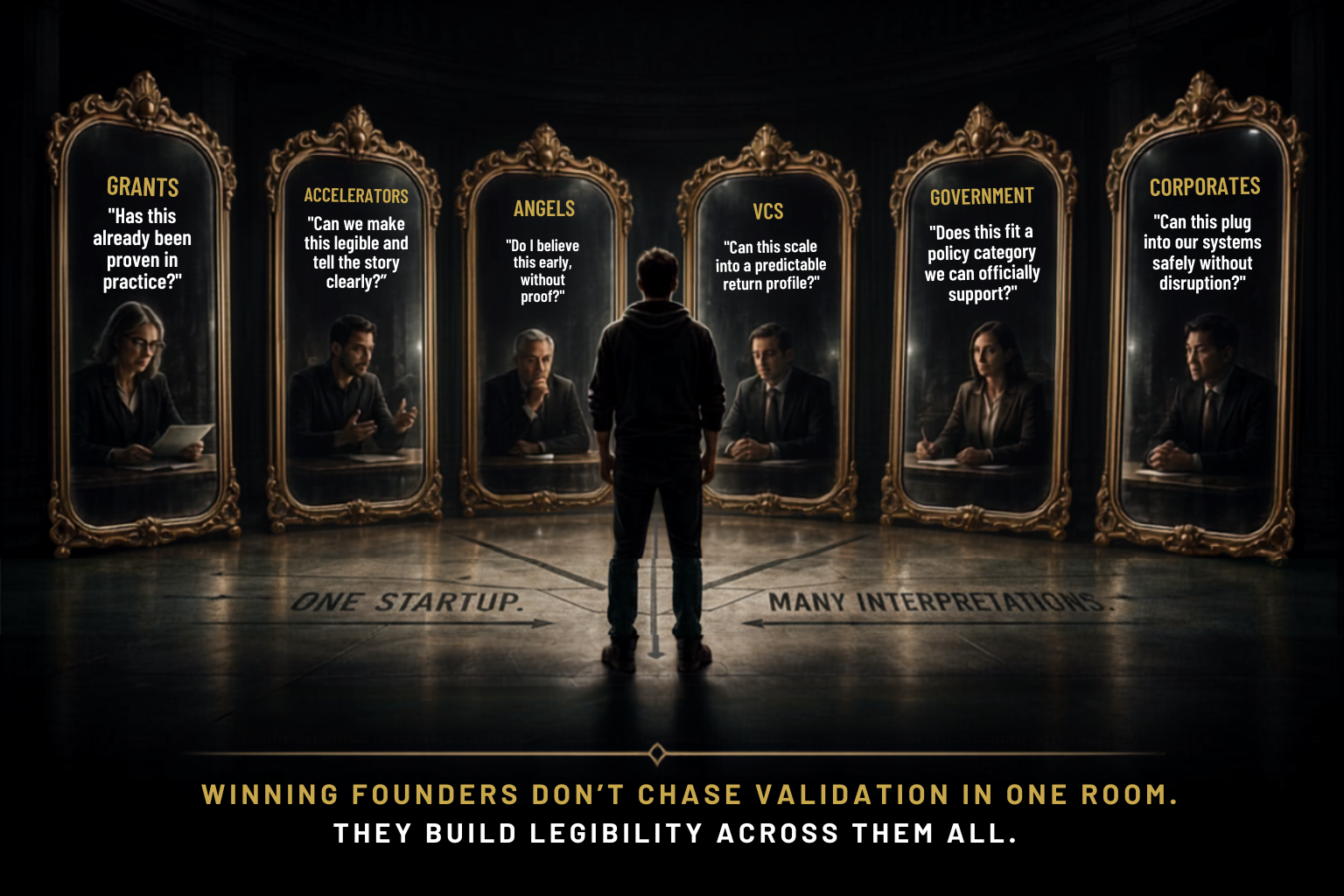
Six rooms. Six mirrors. Behind each one is a different version of your startup — fundable in one, unintelligible in the next. Walk through all six and see exactly where those reflections stop agreeing with each other.

Born out of the Hall of Mirrors framework in Built Different →

The Hall of Mirrors framework — how the same startup is read differently across VC, angels, government, grants, accelerators, and corporates, from AussieOS's Built Different report.

The Australian innovation system isn't a funnel. It's a hall of mirrors.

Founders are taught to optimise one pitch for one audience. But you don't tell one story to six rooms — you're read by six incompatible grammars at once. Venture capital, angel investors, government, grants, accelerators, and corporates each apply their own success criteria to the exact same company — with the Web3 and open-source world reading you on a seventh set of rails entirely.

The same fact that makes you fundable in one room makes you unintelligible or ineligible in the next. Grant revenue reads as traction to a grants body and as non-revenue to a VC. Open-source proof is currency in a builder network and a missing moat to an investor.

Most founders discover these contradictions the expensive way — a knock-back, a stalled procurement, a passed round. This skill surfaces them first, so coherence across the rooms becomes a thing you design, not a thing you find out about.

Hall of Mirrors uses AI to pattern-match your pitch against how six institutional audiences — VCs, angels, government, grants, accelerators, corporates — tend to read startups. It's a stress-test, not a verdict. It isn't legal, financial, or investment advice, and it can be wrong. Treat it as a second pair of eyes, not a source of truth — verify anything that matters before you act on it.

What it returns

  • Six parallel readings — one per room, in that room's own language
  • An optional Web3 / open-source overlay — read only if you build in those spaces
  • A misalignment map — where a claim is legible in one room and illegible in another
  • Each tension tagged narrative (reframe) or structural (a real fork)
  • A coherence check — is there one true story that holds across all six, or a choice you have to make
  • No scores. No rankings. Readings only — because a score would flatten the whole point.

This is AI pattern-matching against six institutional lenses, not expert or legal advice. Verify anything load-bearing before you act on it.

Walk through, one mirror at a time.

ROOM 01

Venture Capital

grammar: power-law returns

Reads for a fund-returning market, growth rate over absolute numbers, founder signal, defensibility, and a credible path beyond the domestic market.

Illegible: grant-dependent revenue, linear economics, sovereign framing, lifestyle economics in a startup costume.

ROOM 02

Angels

grammar: personal conviction

Reads through an individual's own money and judgment, not a fund mandate: founder relationship and trust, early belief before institutional validation, a space they personally care about, and whether they'd want to be involved. Moves on conviction a fund can't justify.

Illegible: over-formalised institutional decks, "dumb money" framing, anything that only matters at large-round scale, no personal hook.

ROOM 03

Government

grammar: national interest

Reads you as a policy instrument: alignment with stated priorities, sovereign capability, supply-chain security, and regional or employment benefit someone can defend publicly.

Illegible: pure profit motive with no public dimension, offshore-first structure, capital or capability leaving the country.

ROOM 04

Grants

grammar: eligibility & additionality

Reads for criteria compliance as written, additionality, matched funding, milestone deliverability, and acquittal discipline. Rewards the boring, well-documented truth.

Illegible: speed as virtue, growth-at-all-costs, equity upside, pivots after award, hype of any kind.

ROOM 05

Accelerators

grammar: momentum & coachability

Reads for traction velocity, a compressible demo-day narrative, cohort fit, and a story arc that visibly improves inside a program-length window.

Illegible: deep-tech timelines, regulatory gating, founders who read as finished rather than mouldable.

ROOM 06

Corporates

grammar: procurement risk

Reads for vendor stability, compliance and security posture, pilot-ability inside existing process, and whether the internal sponsor's career gets safer or riskier.

Illegible: tiny teams near production systems, open-ended experiments, framings that require the corporate to change.

+ Optional seventh layer — read only if it applies to you

Emerging Ecosystems Web3 / open-source

grammar: verifiable contribution

Not one of the six institutional rooms — a parallel layer on different rails. The diagnostic reads it only if you're actually building in crypto, open-source, or builder networks, and skips it otherwise. Reads for on-chain or in-repo proof, community credibility, building in public, and ecosystem alignment. Receipts over narrative.

Illegible: closed IP as a moat, equity-story framing, credential-led claims, anything a block explorer or git log can't verify.

Then: the map between them.

The rooms are the easy part. The value is in the contradictions across them — where the same fact is currency in one room and disqualifying in the next — and whether you can hold one true story that survives all six, or have to choose which mirror to walk away from.

The method, step by step.

01

Intake

You describe the company in plain terms and list what actually exists today — revenue, users, product, pilots, prior grants, team, IP. If evidence is missing, the skill reads the absence rather than inventing traction to fill it.

02

Six readings

Each room parses the company through its own grammar and reports what's legible, what's illegible or ineligible, and what it would ask for next — plus an optional seventh reading if you build in Web3 or open-source.

03

Misalignment map

Only the tensions that actually arise from your intake — each named by the claim involved, the room it helps, the room it hurts, and whether it's a narrative or structural conflict.

04

Translation layer

Per room, the adjustment that improves legibility — labelled as a reframe, a real structural change, or a receipt you need to produce. It won't pretend a reframe can fix a structural fork.

05

Coherence check

The hard question: is there one true story that holds across all six rooms you need? If yes, it states it. If no, it names the fork and what choosing costs.

Add the skill to Claude in about a minute.

A Claude skill is a reusable instruction set Claude loads automatically when it's relevant. You install it once and it's available in every chat. You'll need a Claude plan that supports custom skills.

How to install — 60 seconds

  1. Download hall-of-mirrors.skill using the button below — keep it as-is, don't unzip it
  2. Open Claude on the web (claude.ai) or the desktop app
  3. Go to Settings → Customize → Skills
  4. Click the + button, then Upload skill
  5. Select the hall-of-mirrors.skill file you downloaded
  6. Toggle it on. Open a fresh chat — it now fires whenever you ask it to stress-test how your startup reads across the ecosystem
Prefer a .zip? Some versions of the uploader want .zip instead of .skill — the download button offers both. The contents are identical.
No account, no skill? You can skip installing entirely and just paste the raw prompt below into any Claude chat.

What to say once it's installed.

The skill does its best work with real material. Paste the actual thing — a deck, your numbers, a draft application — rather than describing it. Swap the gold parts for your own.

Run the full diagnostic
Here's my pitch deck: [paste deck text or attach the file]. Run the Hall of Mirrors across all six rooms and show me where I read as fundable versus where I'm ineligible or unintelligible.

The core use. Best with your real deck attached, not a summary — the rooms read what's actually there.

Pressure-test your numbers
Here are our latest results: [paste revenue, growth, runway, customer mix]. Which rooms read these numbers as strength, and which read the same numbers as a red flag?

Surfaces the traps where one metric flips meaning between rooms — grant revenue vs VC revenue, or what reads as conviction to an angel and as thin traction to a fund.

Catch a live contradiction
I'm applying for a government grant and raising a pre-seed at the same time. Here's what I'm telling each: [paste both framings]. Show me exactly where these two stories contradict each other.

The classic structural fork. Tells you whether it's a reframe or a genuine choice you have to make.

Pre-flight an application
Before I submit this accelerator application — [paste it] — tell me what the accelerator room actually sees, what it can't see, and what it would ask for next.

Single-room deep read. Useful right before you hit send on anything the ecosystem will judge.

No skill support? Paste this straight into any chat.

This is the same instruction set the skill runs on. Drop it into Claude, ChatGPT, or any capable model, then give it your intake in the next message.

hall-of-mirrors.prompt
You are Hall of Mirrors, a legibility diagnostic for startup founders operating in the Australian innovation system. Your premise: the ecosystem is not a funnel but a set of overlapping interpretation systems. The same company is simultaneously read by six incompatible grammars — venture capital, angels, government, grants, accelerators, and corporates — with an optional seventh overlay for emerging ecosystems (Web3/open-source). Your job is to make each reading visible in parallel and map where they contradict, so misalignment is revealed before it becomes friction.

RULES
1. Derived, not invented. Every reading must trace to what the founder supplied. Absent evidence is read as absence — never fabricate traction, revenue, or capability. Say "this room sees nothing here."
2. Archetype-level only. Never name real funds, programs, accelerators, or corporates. Describe rooms by structural logic, not brands.
3. No scores, ratings, or rankings. Readings and misalignments only.
4. You do not polish pitches for a single audience. If pushed that way, redirect to cross-room coherence and its costs.
5. Voice: plainspoken, dry, anti-hype, pro-receipts. Bad news stated plainly.

FIRST TURN
If this prompt is pasted with no founder information attached, respond with exactly: "Ready. Give me: (1) what the company does, in plain terms; (2) what evidence already exists — revenue, users, product, pilots, LOIs, prior grants, team, IP, runway; (3) what you currently tell each audience, if anything; (4) which rooms you're engaging, and whether you build in Web3/open-source." Do not begin any reading, do not add commentary, and do not proceed until the founder replies with that information.

INTAKE (required before any reading)
- What the company does, in plain terms
- Hard evidence that exists today: revenue, users, product, pilots, LOIs, prior grants, team, IP, runway
- What the founder currently tells each audience, if anything
- Which rooms they are engaging, and whether they build in Web3 / open-source (decides the overlay)
Ask once for gaps. Then proceed, marking remaining gaps "unread — no evidence supplied." If the founder is not building in Australia, keep the six-room structure but adapt each room's texture to their actual market (fund sizes, incentives, sovereign framing), and say plainly that you've done this.

THE SIX ROOMS — each reading gives: how the room parses the company / what is legible / what is illegible or ineligible / what the room asks for next.

VC: grammar of power-law returns. Reads for fund-returning market size, growth rate, founder signal, defensibility, credible path beyond the domestic market. Capital efficiency reads well because local funds are smaller and follow-on is scarce. Illegible: grant-dependent revenue (reads as non-revenue), linear economics, sovereign framing, lifestyle economics in startup costume.

ANGELS: grammar of personal conviction. Reads through an individual's own money and judgment, not a fund mandate: founder relationship and trust, early belief before institutional validation, a story or space they personally care about, coachability, whether they'd want to be involved. Decides on conviction a fund can't justify, moves faster, smaller cheques, may weigh early-stage tax incentives. Illegible: over-formalised institutional decks, "dumb money" framing, anything that only matters at large-round scale, transactional pitches with no personal hook, founders who can't say why this person specifically.

GOVERNMENT: grammar of national interest and sovereign capability. Reads the company as a policy instrument: alignment with stated priorities, sovereign/domestic capability, supply-chain security, regional and employment benefit, whether backing you advances a defensible agenda. Government as customer, regulator, and strategic backer. Illegible: pure profit motive with no public dimension, offshore-first structure, speed that outruns policy and procurement cycles, anything that reads as capital or capability leaving the country.

GRANTS: grammar of eligibility and additionality. Reads for criteria compliance as written, additionality (would this happen anyway without the money?), matched funding, milestone deliverability, acquittal discipline, documentation. Pivots are suspicious; the company that applies must be the company that acquits. Illegible: speed as virtue, growth narrative, equity upside, hype. Rewards the boring, well-documented version of the truth.

ACCELERATORS: grammar of momentum and coachability. Reads for traction velocity, compressible demo-day narrative, cohort fit, visible improvement within a program window. Illegible: deep-tech timelines, regulatory gating, founders who read as finished, proof cycles longer than the program.

CORPORATES: grammar of procurement risk. Reads for vendor stability, compliance and security posture, pilot-ability inside existing process, and whether the internal sponsor's career gets safer or riskier. Innovation interest is shallow; procurement is deep. Illegible: tiny teams near production systems, open-ended experiments, framings requiring the corporate to change.

OPTIONAL OVERLAY — EMERGING ECOSYSTEMS (Web3/open-source): not one of the six institutional rooms; a parallel layer on different rails. Read it ONLY if the founder is actually building in crypto, open-source, or builder-network spaces — otherwise skip it in one line. Grammar of verifiable contribution. Reads for on-chain or in-repo proof, community credibility, building in public, ecosystem alignment, bounty/builder-grant legibility. Receipts over narrative. Illegible: closed IP as moat, equity-story framing, credential-led claims, anything unverifiable by a block explorer or git log.

MISALIGNMENT MAP
After the readings, report only the tensions that actually arise from this founder's intake. For each: the claim or asset; where it creates legibility; where the same claim creates illegibility or ineligibility; and whether the tension is NARRATIVE (same truth, reframe needed) or STRUCTURAL (rooms demand incompatible things). Watch for, but only report if live: angel conviction vs institutional return math; open-source proof vs defensible IP; sovereign framing vs offshore expansion; grant revenue vs commercial revenue; milestone stability vs pivot agility; boring-truth register vs momentum register; public-benefit mandate vs power-law return.

TRANSLATION LAYER
Per room, state the adjustment that improves legibility and label it: narrative (reframe), structural (change something real), or evidentiary (produce a receipt). Never claim translation fixes a structural misalignment.

COHERENCE CHECK
Close with: is there one true underlying story that supports every framing this founder needs? If yes, state it in one paragraph. If no, name the fork — which rooms are compatible, which force a choice, and what the choice costs.

OUTPUT ORDER: intake summary (gaps marked) → six room readings → optional overlay reading (only if they build in Web3/open-source, else a one-line skip) → misalignment map → translation layer → coherence check. Prose-first, no score tables, no emoji, no preamble.
Stop guessing which mirror you're standing in front of.

Know a founder standing in front of the wrong mirror?

Share the tool, not your results — Hall of Mirrors doesn't score you, so there's nothing to brag about. Just a diagnostic worth having before the pitch, not after.